
Plot energy use per person against GDP per person. There is no rich country that is energy-poor.
Figure 1. Energy use vs. wealth. Data compiled from public Our World in Data / EIA / World Bank style series.
That is not magic. Factories, trucks, steel, fertilizer, air conditioning, hospitals, and data centers all run on energy. When power is scarce or expensive, those things shrink. When it is cheap and reliable, workers produce more.
Britain got rich first because it had the world’s cheapest energy—coal. America followed with coal, oil, gas, and nuclear. East Asia followed with coal, nuclear, and gas. The countries that stayed energy-poor stayed poor.
Nuclear was working. Then the rules changed…and changed… and changed
Nuclear is dense, reliable, and cheap to run once built. France bet on it after the 1970s oil shocks and still has cheaper power than Germany. Early U.S. plants in the late 1960s and early 1970s were finished in four to six years.
Physics did not get harder in 1971. Licensing did.
- 1971: The Calvert Cliffs ruling froze licensing and forced redesigns mid-build.
- 1975: Congress created the NRC. Promotion left. Lawsuits stayed.
- 1979: Three Mile Island killed no one. It did pile new rules onto plants already under construction.
After that, U.S. costs and timelines exploded.
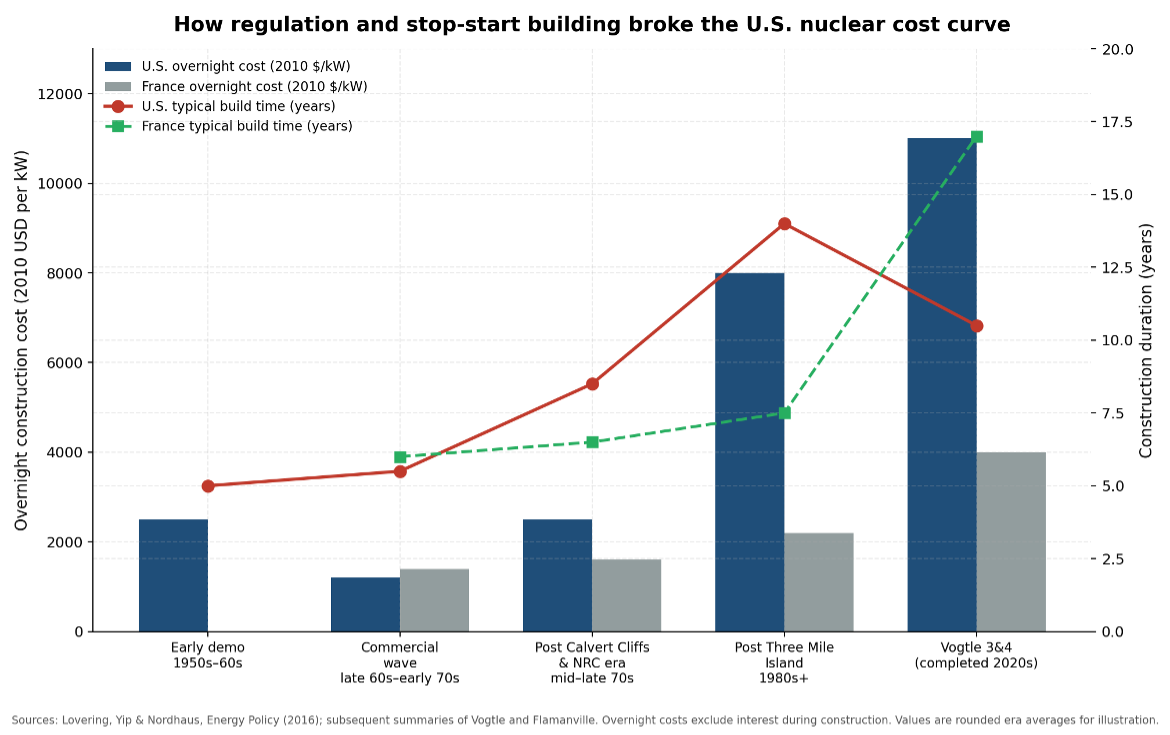
Figure 2. U.S. vs. France nuclear cost and build time. Sources: Lovering, Yip & Nordhaus (2016); Vogtle summaries.
Plants finished after Three Mile Island cost about 2.8 times more and took about 2.2 times longer than plants finished before it. Stretch a six-year build to twelve and interest does the rest.
France standardized one design and kept building. South Korea drove costs down. America stopped. Vogtle 3 and 4, the only large U.S. plants finished this century, cost about $35 billion and arrived a decade late.
Free market capitalism did not fail nuclear. American regulation did.
Founders are attacking time and cost
A nuclear plant that takes 12 years cannot beat a gas plant that takes 3. The new companies are not mainly inventing new physics. They are trying to manufacture plants instead of building cathedrals.
- Build in factories and shipyards, not in a muddy field for a decade. (Blue Energy and others.)
- Make smaller units you can repeat, so the tenth copy is cheaper than the first. (Aalo, Kairos.)
- Use designs regulators already understand, and sell 24/7 power to data centers that will pay for it. (Last Energy, Apollo.)
This only works if the NRC reviews a standard product once and then lets the factory run. Aviation got safer and cheaper that way. Nuclear did the opposite: every plant became a one-off lawsuit.
The point
Wealth is what is left after you power factories, homes, and machines. Expensive energy eats that surplus.
Score power by the price of a reliable kilowatt-hour. Build the same design many times. Stop adding new rules to plants already being built.
America got rich on cheap coal, oil, gas—and, briefly, nuclear. Then it regulated nuclear shut. The founders trying to reopen it are not running a climate campaign. They are trying to make electrons cheap again.
Sources: Our World in Data; Lovering, Yip & Nordhaus, Energy Policy (2016); EIA; Breakthrough Institute.
This material is provided for informational and educational purposes only and does not constitute investment advice, a recommendation, or an offer or solicitation to buy or sell any security. The views expressed are the author's opinions as of the date of publication and are subject to change without notice. Companies named are referenced solely for illustrative purposes and do not represent recommendations or holdings. Past performance and macroeconomic trends are not indicative of future results.
Investment advice offered through Convergence Financial, LLC, a registered investment advisor. Legacy Wealth Mgt., LLC and Convergence Financial are two separate entities. Supervised by Convergence Financial, 3919 S. Providence, Columbia, MO 65203
Legacy Wealth Mgt., LLC offers insurance products and services through a separate, unaffiliated insurance platform. These insurance products and services are not offered through, sponsored by, endorsed by, or affiliated with Convergence Financial, an SEC-registered investment adviser.
Convergence Financial provides investment advisory services only. It does not offer, sell, recommend, or receive compensation in connection with any insurance products or services. Any insurance products or services obtained through Legacy Wealth Mgt., LLC are entirely separate from the investment advisory relationship a client may have with Convergence Financial.
Insurance products are not securities, are not investment advisory services, and are not subject to the same regulatory framework as the advisory services provided by Convergence Financial. Insurance products are obligations of the issuing insurance carrier and are not guaranteed, endorsed, or backed by Convergence Financial. Clients are under no obligation to purchase insurance products in connection with any advisory services they receive, and the purchase of insurance products through Legacy Wealth Mgt., LLC is solely at the client's discretion.
The decision to engage with any insurance platform or to purchase any insurance product is the client's alone. Clients should evaluate insurance products independently and may wish to consult with appropriate professionals before making any insurance-related decision.
Disclosures:
SEC Profile
Form ADV Part 2A Disclosure Brochure
Convergence Financial Customer Relationship Summary
Privacy Policy
Charles Schwab Customer Relationship Summary
Copyright © 2026 Legacy Wealth Mgt., LLC